
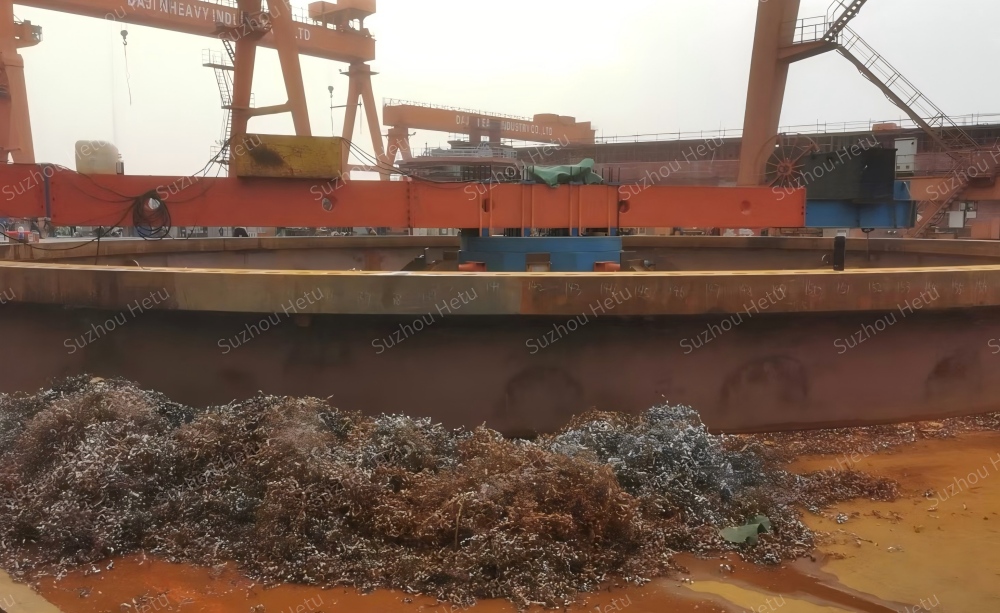
The Challenge: Beyond Standard Limits
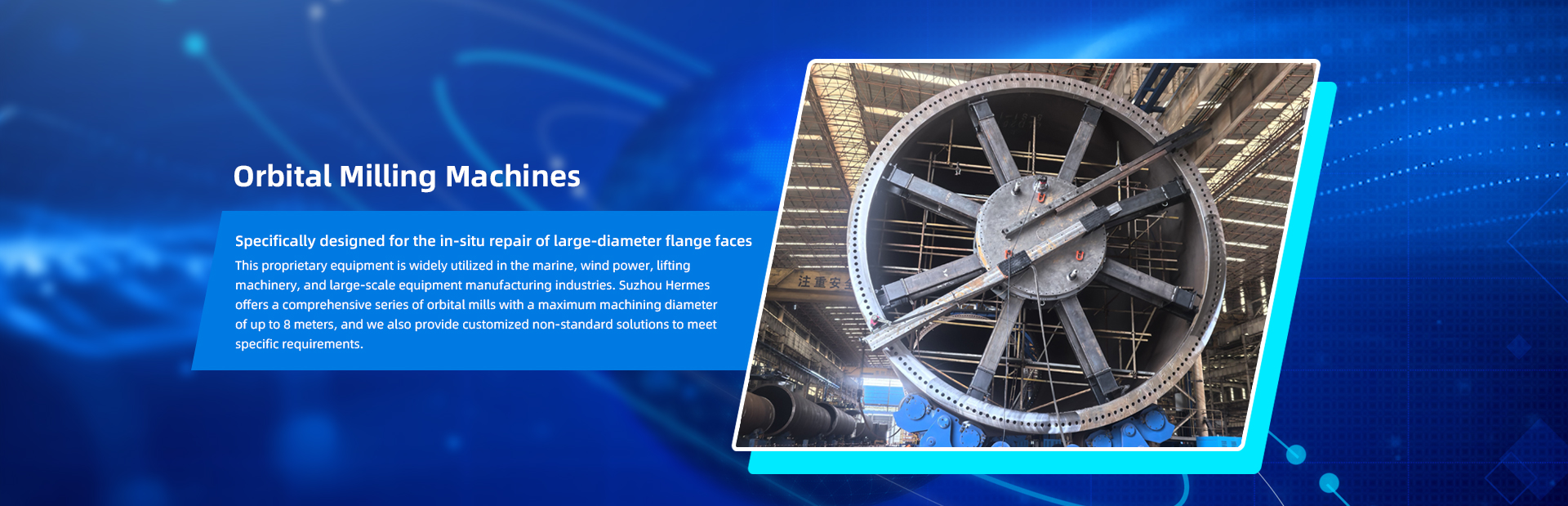
Taking the flanges on heavy-tonnage floating cranes as a prime example, with diameters approaching 20 meters, high-precision restoration of the circumferential surface presents an exceptionally demanding engineering challenge.
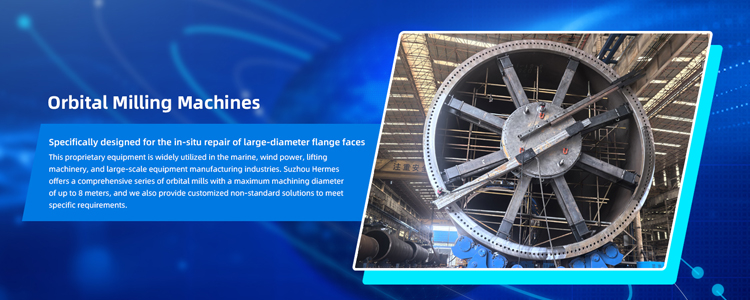
Standard orbital milling machines are entirely unsuitable for such ultra-large scales. When the surfacing arm extends beyond 10 meters (corresponding to a 20-meter machining diameter), relying solely on a central support to drive rotation fails to suppress severe oscillations during operation. The magnitude of this vibration is so significant that it renders stable milling operations impossible.
Engineering Solution: Structural Reinforcement & Dynamic Stability
To overcome this, a complete redesign of the machine structure was mandatory. We introduced an auxiliary support system capable of dynamically counteracting deflection and vibration throughout the surfacing arm's movement. This innovation ensures the necessary structural rigidity and machining precision, fundamentally distinguishing our custom configuration from standard off-the-shelf orbital mills.
Material Science: Overcoming Heat Treatment Constraints
Large-scale equipment also faces critical material selection hurdles. Due to the limited capacity of industrial heat treatment furnaces, oversized components cannot undergo integral heat treatment. Consequently, conventional structural steel fails to meet the required strength and stability standards.
The solution necessitated the use of ultra-high-strength special alloy materials. However, these alloys present dual challenges: extreme difficulty in machining and exorbitant costs, posing a severe test for overall project budget control.
Powertrain & Transmission: Precision under Heavy Load
The design of the power and transmission systems was equally critical. Driving such a massive restoration device smoothly required precise calculation of input power and optimal distribution of the power path. Every component—from the main drive motor to the spindle cutter at the surfacing arm's tip—underwent rigorous mechanical simulation and multi-round scheme validation.
By leveraging professional software for stress analysis on key components and conducting extensive technical workshops with suppliers of gears, motors, and specialty materials, we ensured the system's reliability and durability under conditions of heavy load, low speed, and high torque.
Outcome: Innovation Delivered
Confronted by these formidable technical barriers, our engineering team worked tirelessly for over ten days, reviewing extensive domestic and international literature and iteratively refining the design. The result was the successful development of a customized milling system dedicated to 20-meter class flange restoration.
In subsequent field applications, the equipment demonstrated stable operation and precision compliance, successfully completing the client's delivery mission and earning high acclaim for its performance.